


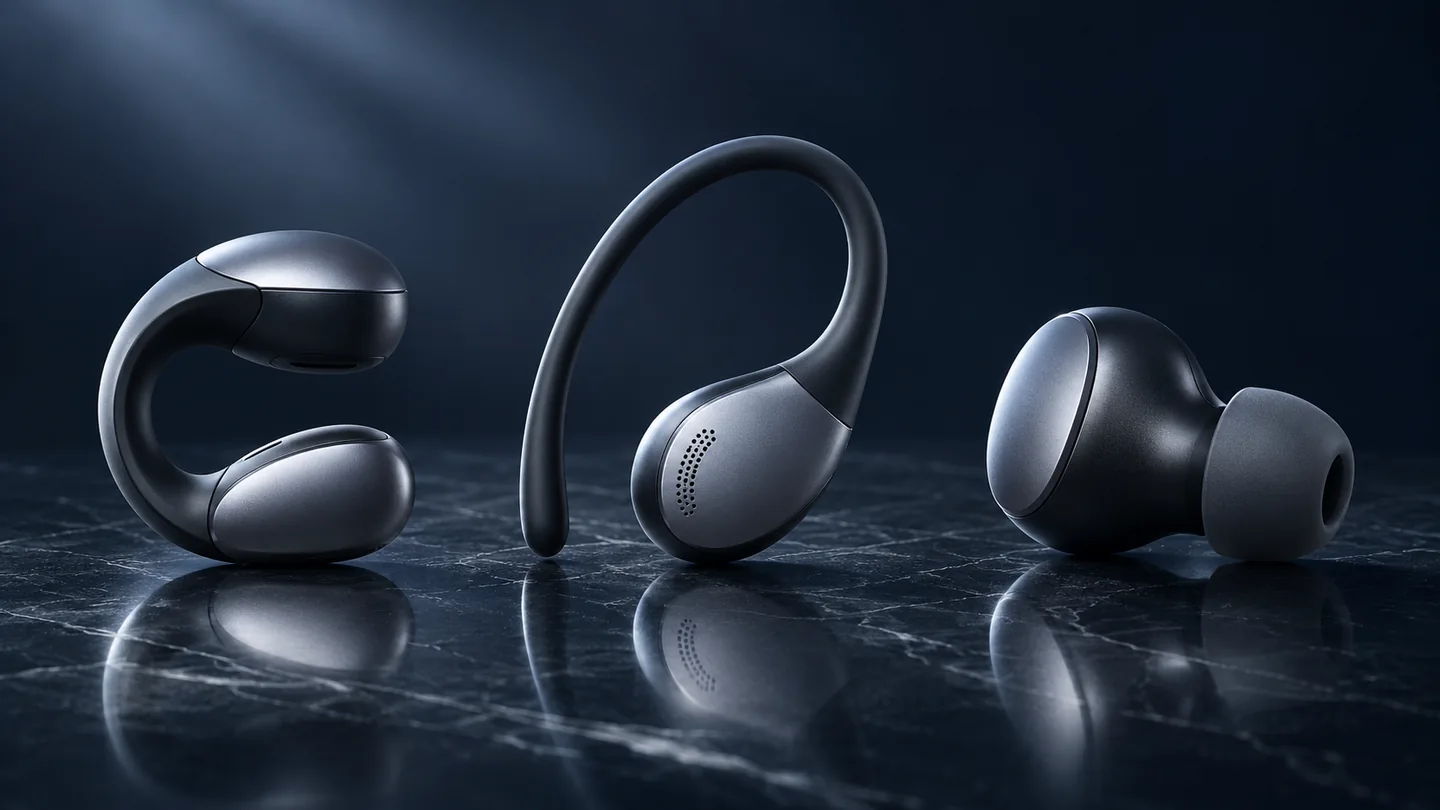
If you dislike silicone tips or want music without fully closing yourself off from the room, open-ear earbuds are worth understanding. The label describes a listening arrangement, rather than one universal shape, sound quality or feature list. A small speaker near the ear, a cuff at its side and an open ring can all approach that goal differently.
This is a source-based format guide, checked November 2, 2026. Product examples explain design differences; QGH has not conducted a comparative listening or comfort test. All three images are AI-generated category illustrations.
What makes an earbud open-ear?
The useful starting question is whether the design seals the ear canal. Soundcore describes open-ear listening as leaving that passage open while delivering audio through air conduction or bone conduction. That is a broader category than a particular clip or ear hook. Read a model’s own explanation before inferring how its sound reaches you.
For shopping, separate three decisions: where the device rests, how it produces sound, and what its software can do. A hook is a support structure. Bluetooth is a connection. Noise reduction on a call microphone is another feature again. None of those terms, by itself, tells you whether an ear tip makes a seal.
Clip-on, ear-hook, open-ring and sealed in-ear
| Format | Where it rests | What to check |
|---|---|---|
| Clip-on / cuff | Around part of the outer ear | Pressure at the contact points, speaker position and room for jewelry |
| Open-ear hook | A hook supports a speaker near the ear opening | Hook position, glasses and whether the speaker stays aligned |
| Open-ring | An open driver sits at the ear opening with a support | The exact support geometry and the maker’s fit instructions |
| Sealed in-ear | A tip sits in the canal and forms a seal | Tip size, seal and the model’s noise-control features |
The original Bose Ultra Open Earbuds are a useful cuff-style example: Bose places the attachment at the side of the ear. Sony’s LinkBuds Open wearing guide instead identifies a ring-shaped driver, housing and fitting supporter. Those two products show why one generic “put it over your ear” instruction cannot cover the category.
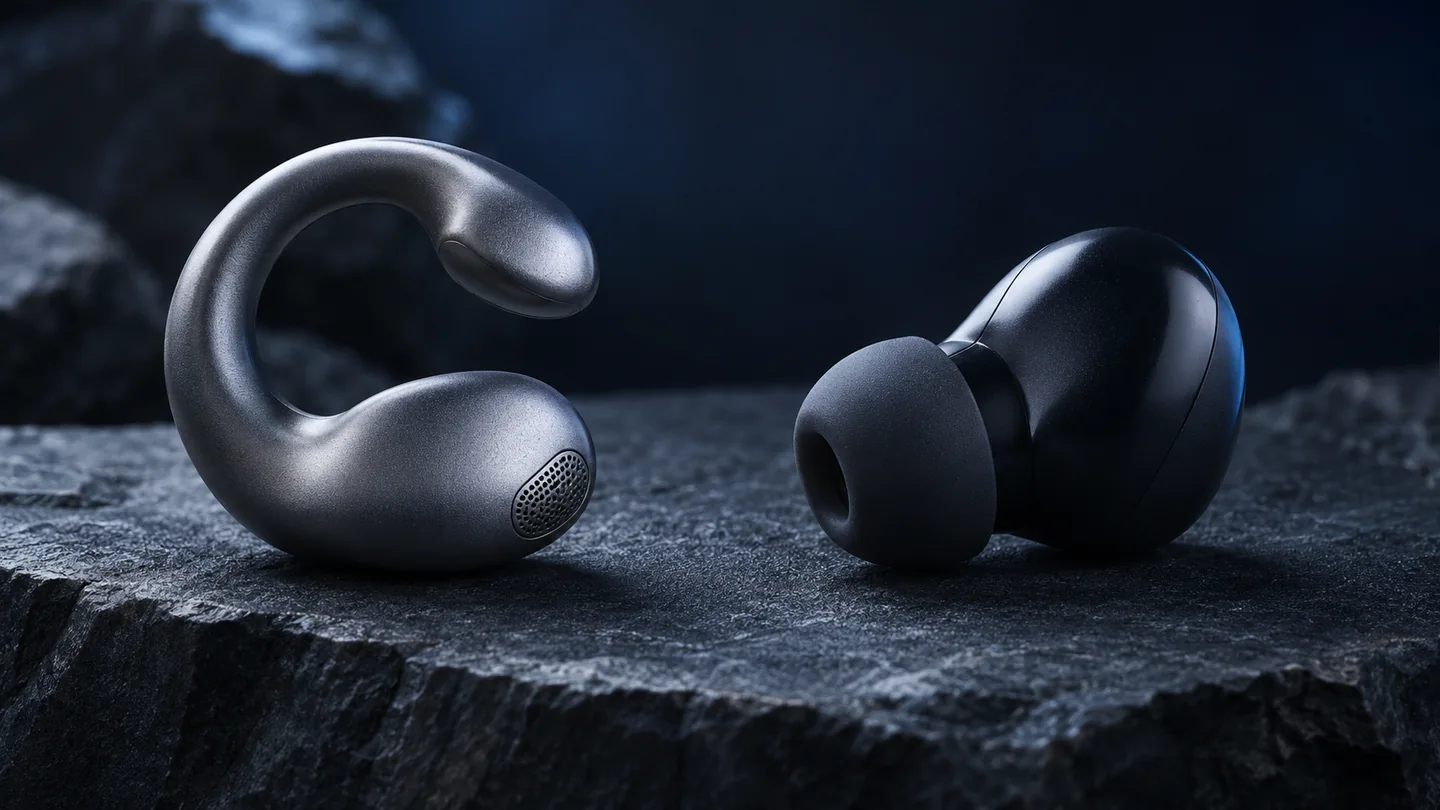
Open-ear does not automatically mean bone conduction
Shokz makes the distinction explicit in its original OpenFit support FAQ: OpenFit uses DirectPitch rather than bone-conduction technology. The name of the brand alone is therefore a poor shortcut for the technology inside every model.
When comparing listings, find the manufacturer’s description of the exact product. If the words air conduction, bone conduction, open fit and ear hook seem to be used interchangeably by a seller, pause and resolve that ambiguity. You may be comparing different physical formats rather than two versions of the same idea.
What to expect from everyday listening
An unsealed arrangement is designed to let outside sound remain part of the experience. That can suit a quiet desk, a conversation break or a household where you need to notice someone speaking. It does not establish that you will hear every important sound in every environment. Treat awareness as a feature to evaluate in context, not a guarantee of safety.

QGH’s practical recommendation is to compare the situations you actually face. Can you follow a podcast at your normal desk without raising the volume repeatedly? Does music stay understandable on your usual route? Are calls usable with the phone and app you own? These are proposed checks for a return-period comparison, not results we have measured.
If you regularly want stronger separation from background noise, compare a sealed model alongside an open one. Our ANC, Transparency and Adaptive Audio guide explains those listening modes. A transparency setting on a sealed earbud and a physically open design are different ways of handling your surroundings.
A short buying checklist
- Identify the fit: clip, hook, ring or sealed tip. Look at the manufacturer’s wearing instructions.
- Confirm the technology: use the exact model description, not assumptions about its brand.
- Check your phone: distinguish basic Bluetooth listening from app controls and ecosystem features.
- Try your own glasses and headwear: a product’s compatibility claim is a reason to try it, not a measurement of your comfort.
- Review the complete kit: case, charging method, accessories and return terms.
For exercise, read our workout audio format guide as a separate comparison. Sweat resistance, controls and movement deserve their own checks; an open fit alone does not settle them.
Common questions
Are open-ear earbuds always clip-on?
No. Clip-on is one attachment style. Ear-hook and open-ring designs can also leave the ear canal unsealed.
Are all open-ear models bone-conduction headphones?
No. The original Shokz OpenFit is one documented counterexample. Check the exact model’s sound technology.
Does open-ear mean nobody nearby can hear the audio?
Do not assume that from the category name. Check the maker’s claims and evaluate your intended listening level and surroundings.
Sources and method
These manufacturer pages explain their own products and designs. QGH’s comparison table and buying checklist are editorial tools for choosing a format, not a ranking of tested earbuds. Features can vary between generations.