


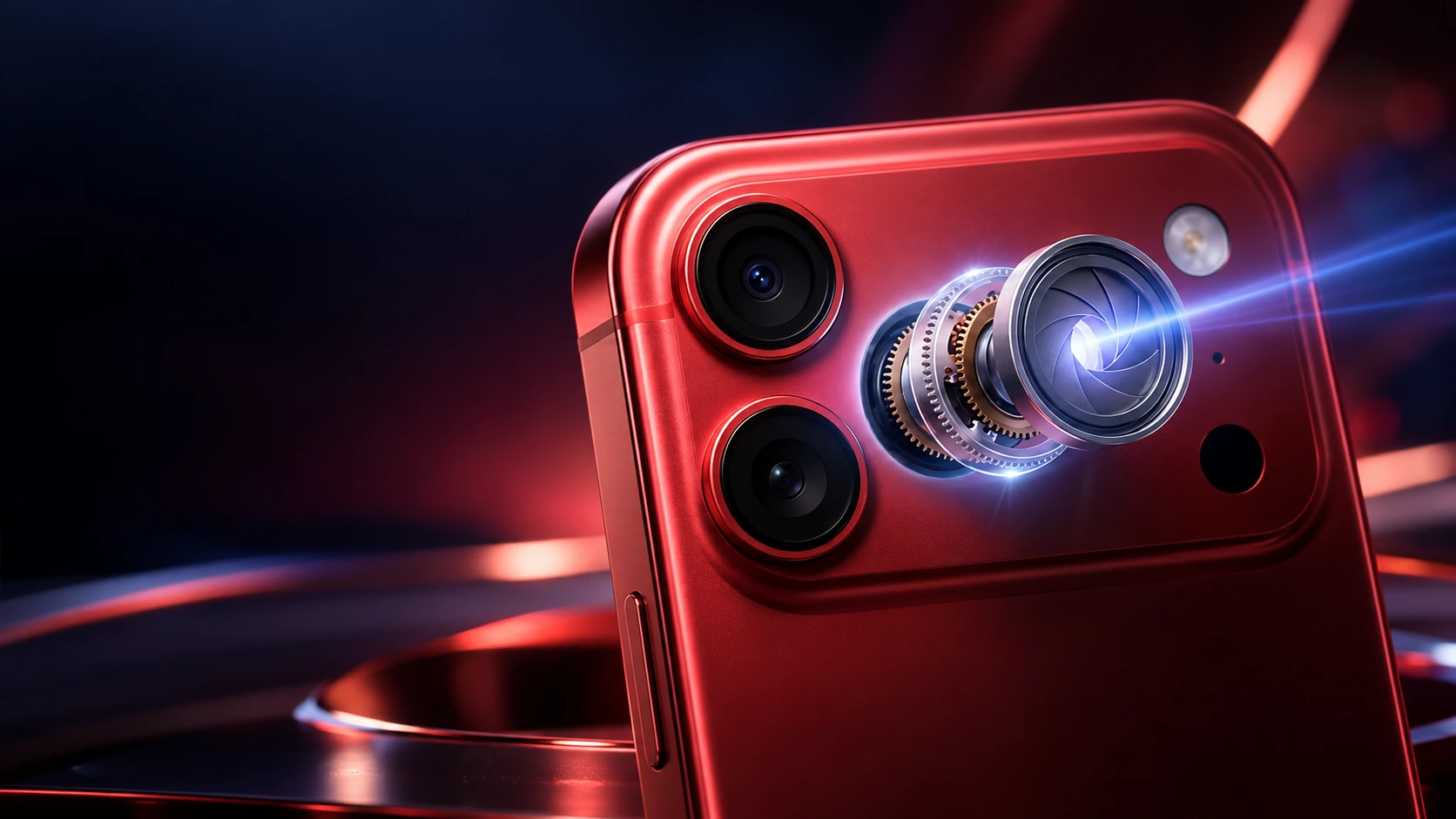
Apple’s iPhone 18 Pro variable aperture is one of the biggest camera changes the company has made in years. For the first time on an iPhone, the Main camera can physically open and close its lens aperture instead of relying on a fixed opening and computational photography alone. That gives the iPhone 18 Pro and 18 Pro Max four aperture settings — ƒ/1.48, ƒ/1.8, ƒ/2.8 and ƒ/4.0 — with automatic control for everyday shooting and manual control through Apple’s new Pro camera interface.
The feature sounds very “pro,” but the useful question is simpler: what does variable aperture actually change for normal photos and video? The answer is less dramatic than switching lenses on a mirrorless camera, but more meaningful than a spec-sheet gimmick. It affects low-light shooting, depth of field, group photos, motion blur and — potentially most importantly — video exposure control.
What is variable aperture on the iPhone 18 Pro?
An aperture is the opening inside a camera lens that controls how much light reaches the image sensor. A wider aperture lets in more light and can produce shallower depth of field. A narrower aperture lets in less light while increasing how much of the scene appears acceptably sharp.
Until now, iPhone cameras used fixed physical apertures. The phone could still brighten or darken an image by changing shutter speed, ISO and computational processing, but the opening in the lens itself did not change.
On the iPhone 18 Pro, Apple uses a mechanical iris with six extremely thin blades. The 48MP Fusion Main camera can move between four physical aperture positions: ƒ/1.48, ƒ/1.8, ƒ/2.8 and ƒ/4.0. Apple can select the aperture automatically based on lighting and depth of field, or users can choose it manually through the Camera app’s Pro Controls. Apple’s iPhone 18 Pro product page describes the system as a way to balance brightness and depth of field without forcing users to think about camera mechanics for every shot.
The four aperture settings explained
| Aperture | What it does | Best use cases |
|---|---|---|
| ƒ/1.48 | Maximum light intake, shallowest native depth of field | Low light, indoor scenes, portraits, faster shutter speeds |
| ƒ/1.8 | Default balance between light and depth of field | Everyday photography |
| ƒ/2.8 | Less light, more of the scene stays sharp | Groups, street scenes, bright conditions |
| ƒ/4.0 | Maximum depth of field available from the system | Group photos, landscapes, creative light-star effects |
Apple says ƒ/1.48 can deliver roughly 50% better low-light performance than its previous setup under the company’s testing conditions. The more important everyday benefit may be the ability to keep shutter speeds faster in dim environments, reducing the chance of motion blur when photographing people, pets or moving subjects.
Why ƒ/1.48 matters more than the marketing makes obvious
The headline feature is “variable aperture,” but the widest new aperture may matter more often than the ability to stop the lens down. The Verge argued that smartphone sensors are still small enough that changes in depth of field between aperture settings are subtler than they would be on a large dedicated camera. In other words, you should not expect DSLR-like transformations simply by moving from ƒ/1.8 to ƒ/4.
What is immediately useful is ƒ/1.48. A wider opening gives the camera more physical light before software processing starts. That can help the iPhone use a faster shutter speed, reduce the need for aggressive Night mode exposure times and preserve more natural texture in difficult lighting. The Verge’s analysis similarly argues that the wider maximum aperture may have more day-to-day impact than the narrower settings.
Group photos are where narrower apertures can help
Phone cameras increasingly simulate shallow depth of field with software, but group photography creates the opposite challenge: you often want multiple people at different distances to remain sharp.
By moving to ƒ/2.8 or ƒ/4, the iPhone 18 Pro can physically increase depth of field. Apple specifically highlights ƒ/4 for scenes where foreground and background subjects both need more detail. That does not eliminate computational photography, but it gives the software better optical information to start with.
This is the type of improvement that may be more useful than dramatic: fewer group photos where one face looks perfect while someone slightly behind it appears softer than expected.
Variable aperture could matter even more for video
Video may be the most interesting use case. Traditional filmmaking often follows a shutter-speed rule designed to keep motion looking natural. In very bright conditions, fixed-aperture phone cameras may have to compensate using faster shutter speeds or external neutral-density filters.
A narrower physical aperture gives the iPhone another way to control exposure before resorting to more aggressive shutter changes. That does not replace an ND filter for serious production, but it gives creators more control directly inside the phone.
Apple has also added manual shutter speed, white balance, histogram and aperture controls to the default Camera app on the 18 Pro models. That combination matters because variable aperture is much more useful when it is part of a broader manual-exposure workflow rather than an isolated hardware feature.
How the mechanical iris actually works
Apple’s implementation is genuinely mechanical. A teardown of the iPhone 18 Pro camera module showed six overlapping blades that form a tiny adjustable iris inside the camera assembly. The mechanism has to move precisely while fitting into a smartphone camera module only millimeters thick.
That engineering comes with a trade-off. iFixit’s teardown coverage shows that the iris is a highly integrated part of the camera module. If the mechanism fails, repair is unlikely to mean replacing a single tiny blade; in practice, the full camera assembly may need replacement.
Does variable aperture replace Portrait mode?
No. Physical aperture and computational portrait blur solve related but different problems.
- Physical aperture changes how light actually enters the lens and affects real optical depth of field.
- Portrait mode uses depth information and software segmentation to simulate a shallower depth of field after capture.
The advantage of combining both is flexibility. Apple can capture better optical data first, then use computational photography only where it adds value. That can create more natural transitions around hair, glasses and complex edges than software blur working from a fixed optical setup alone.
What early reviews say
Early testing suggests variable aperture is useful without completely redefining smartphone photography. TechRadar’s review praised the new camera controls and described the 18 Pro camera upgrades as one of the most meaningful parts of this generation, while still characterizing the overall phone as refinement rather than reinvention. TechRadar’s testing also highlights improvements in battery life, thermal performance and the A20 Pro platform alongside the camera changes.
That is probably the right way to frame variable aperture: it gives creators and advanced users more control, while most people will benefit from it automatically without ever changing the aperture themselves.
iPhone 18 Pro pricing and availability in the U.S.
The iPhone 18 Pro starts at $1,199 in the United States, while the iPhone 18 Pro Max starts at $1,299. Both are available in 256GB, 512GB, 1TB and 2TB storage configurations. Apple began retail availability on September 18, 2026. Apple’s U.S. store lists the current configurations and pricing.
Alongside the camera upgrade, both phones use the A20 Pro chip and Apple’s next-generation vapor-chamber cooling system. If you are interested in how the wider mobile industry is approaching next-generation smartphone silicon and on-device AI, see our Snapdragon 8 Elite Gen 6 analysis.
Should iPhone 17 Pro owners upgrade for variable aperture?
Variable aperture alone is probably not enough reason for most iPhone 17 Pro owners to upgrade. The strongest case is for people who shoot a lot of video, frequently work in difficult lighting or genuinely want manual aperture and shutter control in Apple’s default Camera app.
For casual photographers, the benefit will mostly happen invisibly through automatic exposure choices. That is valuable, but it is closer to a quality-of-life improvement than a completely new photographic experience.
For users coming from older iPhones, the equation is different. Variable aperture arrives alongside a broader set of camera, battery and performance improvements, making the generation more compelling as a complete upgrade rather than as a single-feature purchase.
QGH perspective
The iPhone 18 Pro variable aperture is important because it moves some control back from software into optics. Smartphone photography has spent years using computational processing to overcome tiny lenses and sensors. Apple is now adding another physical tool to the system rather than simply increasing megapixels or adding another AI filter.
The result is not a mirrorless camera in your pocket, and ƒ/4 on a smartphone will not behave like ƒ/4 on a full-frame camera. But the combination of a wider ƒ/1.48 opening, physical aperture control and proper manual exposure tools makes the iPhone 18 Pro a more flexible camera than its predecessor — particularly for low light, group shots and video.
For more Apple hardware coverage, see our iPhone Duo review. You can also follow the latest launches in QGH Tech News or browse our product reviews.
Sources and methodology
This article is a research-based technical explainer, not a hands-on Quantum Gadget Hub test. Specifications, U.S. pricing and availability were checked against Apple’s official iPhone 18 Pro product pages, technical specifications and launch announcement. Practical interpretation of the variable-aperture system was cross-checked against independent reporting and testing from The Verge, TechRadar and iFixit teardown coverage. Manufacturer performance claims are identified as such rather than presented as independent measurements.
[…] you are also evaluating Apple’s newest hardware, see our iPhone 18 Pro variable-aperture explainer and our iPhone Duo review. For more launches, visit QGH Tech […]