


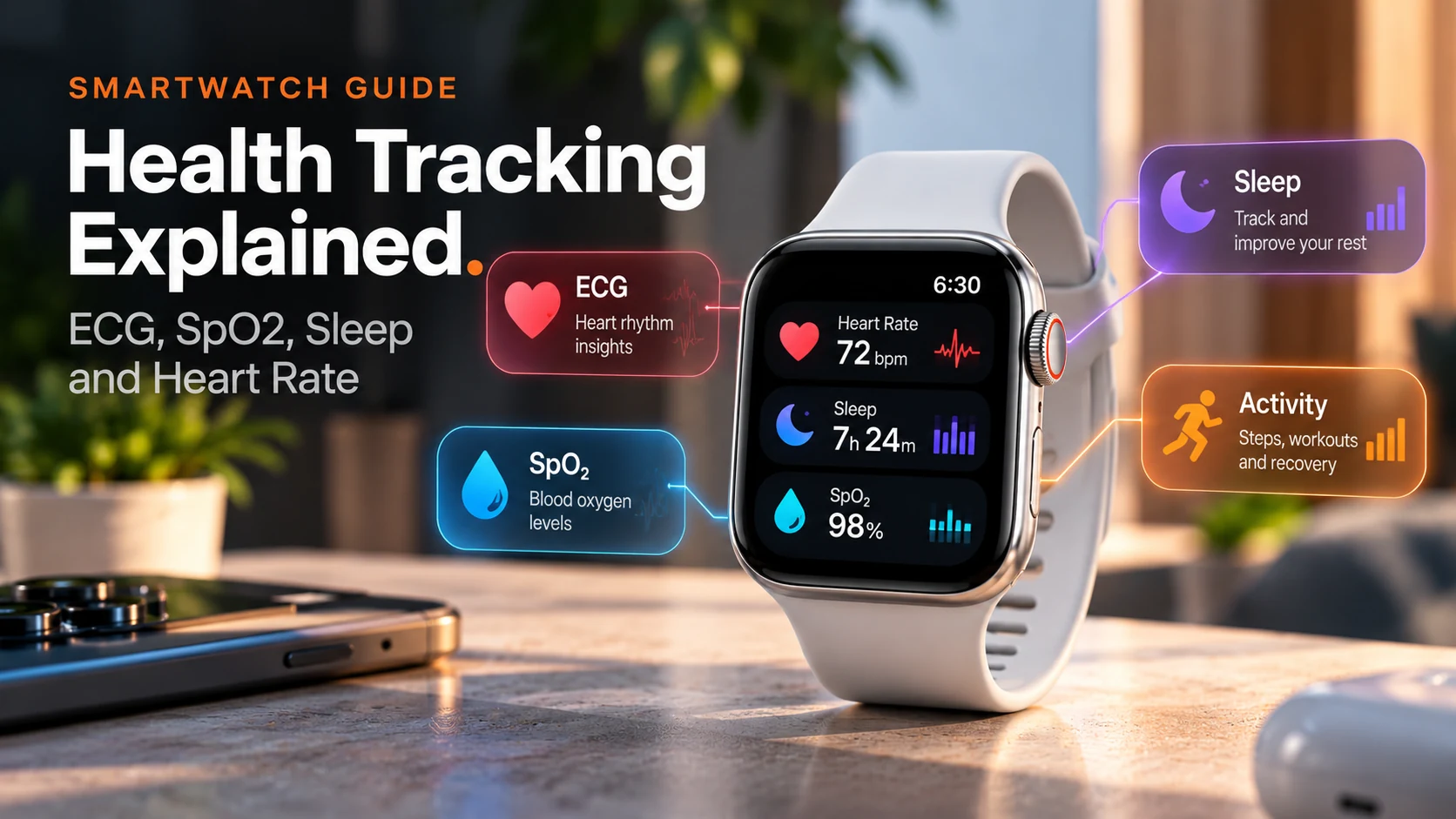
Your smartwatch can collect an impressive amount of health data, but the numbers are not all measuring the same thing. Heart rate, ECG, blood oxygen, sleep stages, skin temperature and recovery scores each have different strengths and limitations. This guide explains what the most common smartwatch health features actually tell you — and what they do not.
Smartwatch health tracking: the short version
Think of a smartwatch as a trend-tracking device, not a replacement for a doctor or medical-grade diagnostic equipment. Its biggest advantage is continuous, convenient measurement over time. A single reading can be noisy; repeated patterns can be more useful for understanding changes in your routine.
Heart rate: the foundation
Most modern smartwatches use optical sensors on the wrist to estimate heart rate. They can track resting heart rate, exercise intensity and changes throughout the day. Fit, motion, skin contact and the type of exercise can affect readings, so wrist-based measurements should not automatically be treated as clinical measurements.
ECG: different from ordinary heart-rate tracking
An ECG-capable smartwatch uses electrical signals rather than only optical pulse sensing. On supported devices and in supported regions, the feature can help users record a single-lead ECG and may flag certain rhythm patterns. That does not mean a watch can diagnose every heart condition. Feature availability and regulatory clearance also vary by country.
Blood oxygen (SpO2): useful context, with limits
SpO2 estimates the percentage of oxygen carried in the blood. Smartwatches typically use red and infrared light to estimate it at the wrist. Movement, fit, skin temperature and other conditions can influence measurements. Availability can also differ by model and market, so buyers should check the exact device and region rather than assume every watch offers the same capability.
Sleep tracking: look for trends, not perfect sleep stages
Smartwatches combine movement, heart-rate signals and other sensor data to estimate sleep duration and stages. Their strongest practical value is often consistency: bedtime, wake time, interruptions and longer-term sleep patterns. Treat precise stage-by-stage estimates as approximations rather than laboratory sleep-study results.
Skin temperature and recovery scores
Temperature sensing is especially useful as a baseline measurement. Watches can look for deviations from your personal pattern rather than simply acting like a traditional thermometer. Recovery or readiness scores go one step further by combining signals such as sleep, activity and heart-rate trends into a simpler recommendation. The exact formula differs by platform, so scores from two brands should not be compared as if they were the same metric.
Apple Watch Series 12 vs Pixel Watch 4 for health
The key difference is not just the sensor list. Apple Watch Series 12 feeds its measurements into the Apple Health ecosystem, while Pixel Watch 4 is built around Google’s health and fitness experience. Your phone ecosystem, the metrics you care about and regional feature availability matter as much as hardware.
For the full comparison, read Pixel Watch 4 vs Apple Watch Series 12. You can also explore our Apple Watch Series 12 guide, Pixel Watch 4 guide and Best Smartwatch Buying Guide 2026.
What should you trust?
- Trust trends more than isolated readings. Repeated measurements under similar conditions are usually more informative than one unusual number.
- Check regional availability. ECG, blood-oxygen and other health functions can differ by country and device version.
- Pay attention to fit. Sensor contact matters, particularly during exercise and sleep.
- Use medical care when appropriate. A smartwatch can provide useful information to discuss with a healthcare professional, but it should not be used to rule out a medical problem.
Bottom line
The best smartwatch health feature is not necessarily the one with the most impressive name. Heart rate, ECG, SpO2, sleep and temperature data become most useful when they fit into a consistent long-term picture. Choose the watch whose health ecosystem you are likely to use every day, understand its limitations, and treat unusual or concerning readings as information to investigate rather than a diagnosis.
QGH research note: This explainer is based on manufacturer documentation and general information about consumer wearable sensors available at publication time. Quantum Gadget Hub did not perform clinical validation of the devices discussed. Health features, regulatory availability and software capabilities can change by region and update.