


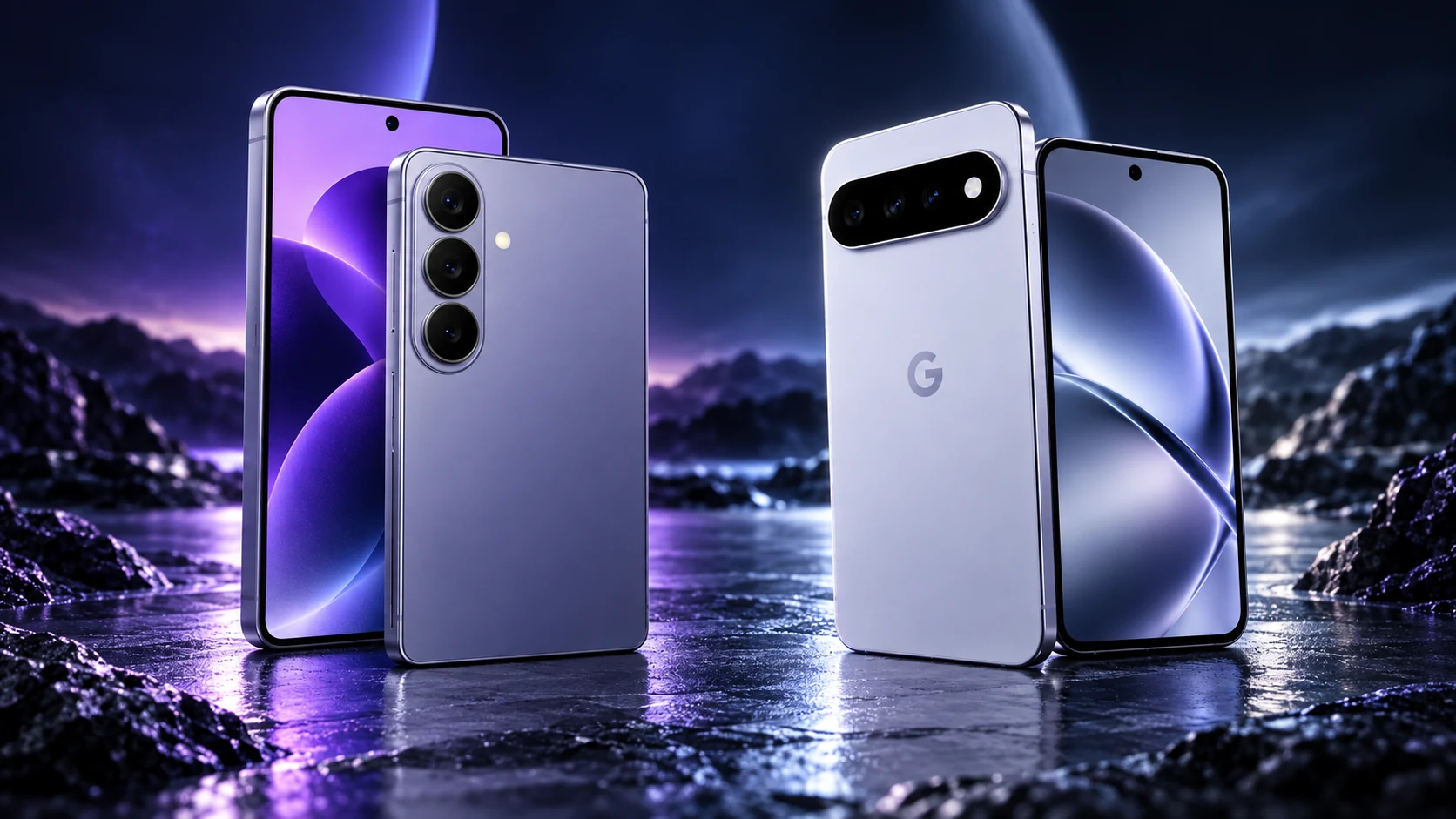
Samsung Galaxy S26 Ultra vs Google Pixel 11: choose the Ultra if you will use its larger screen, S Pen, camera range and performance headroom. Choose the Pixel 11 if you prefer a smaller phone and can put the roughly $400 U.S. launch-price difference to better use. Samsung’s Ultra is the more hardware-focused device; Google’s Pixel is built around a simpler Android and Gemini experience.
Research-based comparison: QGH has not performed a side-by-side laboratory test of these two phones. This article compares official U.S. specifications, manufacturer documentation and the positioning of each device. Prices and promotions can change, so we use U.S. launch MSRP when comparing value.
Galaxy S26 Ultra vs Pixel 11: key differences
| Feature | Galaxy S26 Ultra | Google Pixel 11 |
|---|---|---|
| U.S. launch MSRP | $1,299.99 | $899 |
| Display | 6.9-inch QHD+ AMOLED, 1–120Hz, 2600 nits peak | 6.3-inch OLED, 60–120Hz, 3000 nits peak |
| Processor | Snapdragon 8 Elite Gen 5 for Galaxy | Google Tensor G6 |
| RAM / storage | 12GB with 256/512GB; 16GB with 1TB | 12GB with 256/512GB |
| Main cameras | 200MP wide, 50MP ultrawide, 10MP 3x, 50MP 5x | 48MP wide, 13MP ultrawide, 10.8MP 5x |
| Battery | 5000mAh | 4985mAh typical |
| Wired charging | Up to 60W | 30W-class PPS; up to 55% in about 30 minutes |
| Wireless charging | Up to 25W | Qi2.2 Pixelsnap up to 25W |
| Software at launch | Android 16 / One UI 8.5 | Android 17 |
| Update commitment | 7 years of security updates | 7 years of OS, security and Pixel Drop updates |
| Weight | 214g | 6.9 oz, about 196g |
Price and value: the Pixel 11 starts with a $400 advantage
The biggest difference is straightforward. The Galaxy S26 Ultra launched in the U.S. at $1,299.99 for 256GB, while the Pixel 11 launched at $899 with 256GB. That roughly $400 gap changes how the rest of the comparison should be read.
Samsung is charging for a larger QHD+ display, an additional telephoto camera, much higher-resolution camera hardware, a faster Snapdragon platform, the S Pen, Privacy Display and faster wired charging. Google instead puts most of its value into a compact flagship format, Tensor G6, Gemini features, a 5x telephoto lens and seven years of software support at a lower entry price.
For buyers who do not need Samsung’s extra hardware, the Pixel 11 leaves a meaningful amount of money in the budget for accessories, protection or a future upgrade. For buyers who specifically want the Ultra feature set, the higher price is buying capabilities that the Pixel 11 simply does not offer.
Display and design: compact Pixel or maximum-screen Samsung?
The Galaxy S26 Ultra uses a 6.9-inch QHD+ Dynamic AMOLED 2X display with a 1–120Hz adaptive refresh rate. Samsung also introduces its built-in Privacy Display, designed to reduce side-angle visibility when enabled. The Pixel 11 uses a smaller 6.3-inch Actua OLED display with a 60–120Hz refresh rate and a listed peak brightness of up to 3000 nits.
The practical choice is mostly about size. The Ultra is better suited to people who want a large canvas for video, multitasking, games, photo editing and S Pen use. The Pixel 11 is easier to carry and operate as an everyday phone, and at about 196g it is lighter than Samsung’s 214g Ultra.
Performance: Samsung has the stronger hardware ceiling
Samsung equips the S26 Ultra with the Snapdragon 8 Elite Gen 5 for Galaxy, paired with a redesigned vapor chamber. Samsung positions it for sustained gaming, multitasking, video capture and on-device AI workloads. The Pixel 11 runs Google’s Tensor G6, which is designed around Pixel imaging, security and Gemini experiences rather than simply maximizing benchmark performance.
If your workload includes demanding games, extended camera use, heavy multitasking or creator apps, the S26 Ultra has the more ambitious performance platform. For normal daily use, photography, messaging and AI features, the Pixel 11’s advantage is tighter integration between Google’s hardware, Android 17 and Gemini rather than raw silicon headroom.
Cameras: Samsung gives you more hardware flexibility
The Galaxy S26 Ultra carries a four-camera rear system: 200MP main, 50MP ultrawide, 10MP 3x telephoto and 50MP 5x telephoto. Samsung also supports 4K recording at up to 120fps in Pro Video and 8K at 30fps. The Pixel 11 uses a three-camera system with a 48MP main, 13MP ultrawide and 10.8MP 5x telephoto, with Google leaning heavily on computational photography and its software processing pipeline.
Samsung’s hardware is more versatile on paper, especially if you regularly move between 3x and 5x zoom, shoot high-resolution images or care about advanced video options. The Pixel 11 still gives buyers a true 5x telephoto at a much lower price and remains appealing to photographers who prefer Google’s automated image processing and simpler shooting experience.
For a deeper breakdown of Samsung’s camera hardware and what the specifications mean in practice, the dedicated S26 Ultra Camera Explained article is the separate search intent in this cluster and should remain the detailed camera resource rather than duplicating that analysis here.
Battery and charging: similar capacity, different charging priorities
Battery capacity is surprisingly close: 5000mAh on the Galaxy S26 Ultra and 4985mAh typical on the Pixel 11. Capacity alone does not determine endurance, because the phones use different displays, processors and software power-management strategies.
Samsung has the advantage in wired charging. The S26 Ultra supports up to 60W and Samsung says it can reach about 75% in 30 minutes with the appropriate charger. Google says the Pixel 11 can reach up to 55% in about 30 minutes with a 30W USB-C PPS charger or higher. Both support wireless charging up to 25W, while the Pixel 11’s Qi2.2-certified Pixelsnap system gives Google a particularly straightforward magnetic accessory story.
AI and software: two different Android philosophies
The Pixel 11 launched with Android 17 and is designed around Gemini Intelligence, Gemini Nano and Gemini Live. Google controls the operating system, Tensor platform and its AI services, so the Pixel experience tends to feel like the most direct expression of Google’s current Android strategy.
Samsung takes a broader approach. The S26 series combines Galaxy AI, an upgraded Bixby and access to agents including Gemini and Perplexity. Features such as Now Nudge, Now Brief, Photo Assist and Samsung’s security stack add another layer on top of Android. That gives Samsung more features and customization, while Pixel buyers may prefer Google’s more focused software experience.
Longevity and security
Both phones are designed for long ownership cycles. Google states that Pixel 11 receives seven years of OS, security and Pixel Drop updates from its first U.S. availability. Samsung states that the Galaxy S26 series receives seven generations of OS upgrades and seven years of security updates from its initial global launch, alongside Knox and Knox Vault security.
For buyers who keep a phone for four or five years, both are far more credible long-term purchases than older Android flagships with shorter support windows. Google promises seven years of OS, security and Pixel Drop updates, while Samsung promises seven OS generations and seven years of security updates. The starting date and type of feature updates differ, so neither promise alone should decide the purchase.
Which one makes more sense for you?
Choose the Galaxy S26 Ultra if…
You want the largest display, stronger performance headroom, the most flexible camera hardware, 3x and 5x optical zoom options, S Pen support, faster wired charging or Samsung-specific features such as Privacy Display. It is also the more natural choice for a power user already invested in Galaxy hardware.
Choose the Pixel 11 if…
You want a smaller flagship, prefer Google’s Android and Gemini experience, still want a 5x telephoto camera, value Qi2.2 Pixelsnap accessories and would rather spend $899 than $1,299.99 before promotions. For many mainstream buyers, its lower MSRP is the key advantage.
QGH bottom line
The Galaxy S26 Ultra is the more complete hardware package, but the Pixel 11 makes a stronger argument around simplicity and price. The Ultra’s extra $400 makes sense when you will actually use its larger display, additional camera hardware, S Pen or higher performance ceiling. If those features are not central to how you use a phone, the Pixel 11 delivers most of the modern flagship experience for considerably less.
Explore more comparisons in the QGH Comparisons hub or browse all smartphone reviews.
Sources
Primary specifications and pricing were checked against Samsung U.S. Newsroom, Samsung U.S., Google Store Pixel 11 specifications and Google Pixel update policy and Samsung’s S26 Ultra environmental report (software support). Specifications, promotions and software features can change after publication.