


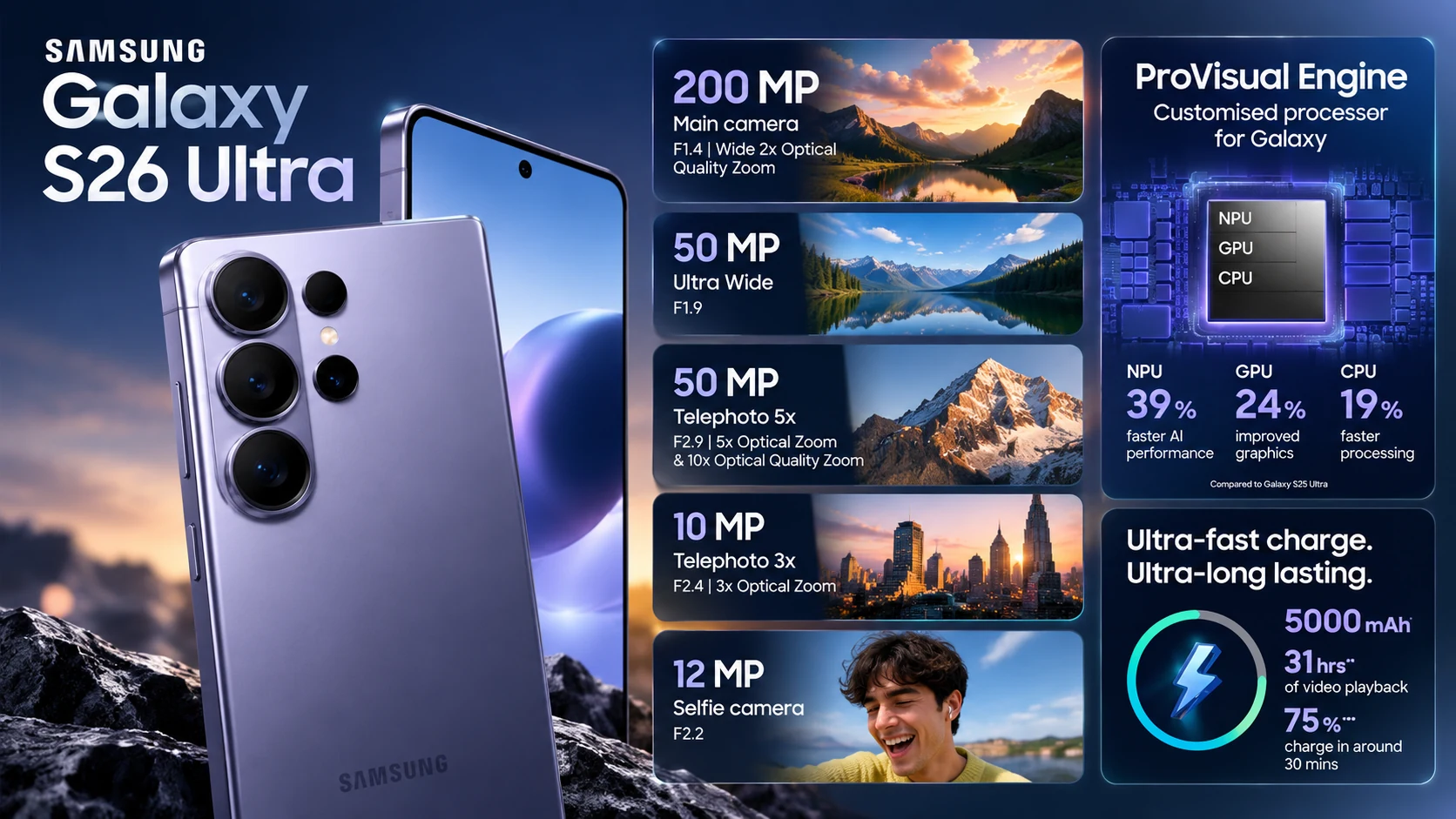
The Galaxy S26 Ultra camera system is built around four rear cameras rather than one headline megapixel number. This explainer breaks down what the 200MP main camera, 50MP ultrawide, two telephoto cameras and Samsung’s computational imaging actually mean in everyday shooting.
QGH methodology: This is a research-based camera explainer, not a claim of direct lab testing. Specifications and feature behavior are checked against Samsung’s published documentation, then interpreted for practical buying decisions. For our overall assessment, see the Galaxy S26 Ultra review.
Galaxy S26 Ultra camera specs at a glance
Samsung’s rear system combines a 200MP wide camera at f/1.4, a 50MP ultrawide at f/1.9, a 50MP 5x telephoto at f/2.9, and a 10MP 3x telephoto at f/2.4. The front camera is 12MP at f/2.2. Samsung lists 3x and 5x as optical zoom positions, while 2x and 10x are described as optical-quality zoom using its Adaptive Pixel sensor system. Digital zoom extends to 100x.
What the 200MP main camera actually does
The 200MP figure is primarily about giving the imaging pipeline more source information. In normal use, the value is not simply producing enormous 200MP files every time. High-resolution sensor data can support cropping, detail reconstruction and pixel processing, while the wide f/1.4 aperture is especially relevant when light levels fall.
For buyers, the practical question is therefore not “does 200MP beat 50MP?” but how consistently Samsung converts that sensor and lens combination into detail, dynamic range, skin tones and low-light results. Megapixels alone cannot answer that.
Why there are two telephoto cameras
The S26 Ultra uses separate 3x and 5x telephoto cameras. The 10MP 3x module targets shorter portrait and medium-distance framing, while the 50MP 5x module provides the longer native optical reach. Samsung also derives a 10x “optical quality” position from the 5x camera rather than using a dedicated 10x optical lens.
That distinction matters when reading marketing claims. 3x and 5x are optical zoom positions. The 2x and 10x settings use sensor-based processing that Samsung classifies as optical quality. Beyond those ranges, increasingly aggressive digital processing becomes part of the result.
The 50MP ultrawide is more than a landscape camera
The 50MP f/1.9 ultrawide provides the widest perspective in the rear system. It is useful for architecture, interiors, groups and scenes where stepping backward is impossible. Its higher-resolution sensor also gives Samsung more information to work with than a lower-resolution ultrawide, although final image quality still depends on lens performance and processing.
Low-light photography: why the aperture matters
Samsung describes the S26 Ultra as its brightest camera system to date. The main camera’s f/1.4 aperture is the specification to watch here: a wider aperture can admit more light, which gives the camera more usable data before computational processing is applied. Samsung’s ProVisual Engine then participates in the processing pipeline for night and general photography.
That does not guarantee every night photo will outperform every rival. Scene movement, exposure choices, noise reduction and computational processing remain important, so low-light superiority should be established through controlled comparisons rather than specifications alone.
Video: 8K is available, but 4K may matter more
Samsung specifies rear-camera video recording up to 8K at 30 fps, plus slow-motion modes including FHD at 240 fps and UHD at 120 fps. 8K offers very high resolution and potential cropping flexibility, but storage use, editing requirements and playback needs mean many buyers will still find 4K the more practical everyday format.
How to think about the S26 Ultra camera before buying
The camera system’s main advantage on paper is flexibility: ultrawide, high-resolution main, 3x telephoto and 5x telephoto cameras cover substantially different framing needs without relying on a single sensor for every focal length. The important caveat is that specifications describe capability, not photographic taste or consistency.
If your decision is between current flagships, our Galaxy S26 Ultra vs Pixel 11 comparison explains the Android trade-offs, while Galaxy S26 Ultra vs iPhone 18 Pro covers the cross-platform choice.
Bottom line
The Galaxy S26 Ultra camera story is less about “200MP” by itself and more about a four-camera system designed to cover multiple useful focal lengths. The 200MP f/1.4 main camera anchors the system, the 50MP ultrawide expands framing options, and dedicated 3x and 5x telephotos reduce dependence on digital zoom at common magnifications. For buyers who value camera versatility, those are the specifications that matter most.
Sources and further reading
Primary specifications and camera feature descriptions were checked against Samsung’s official Galaxy S26 Ultra product documentation and Samsung Newsroom. QGH separates manufacturer specifications from independent interpretation and does not present research-based analysis as hands-on testing.