


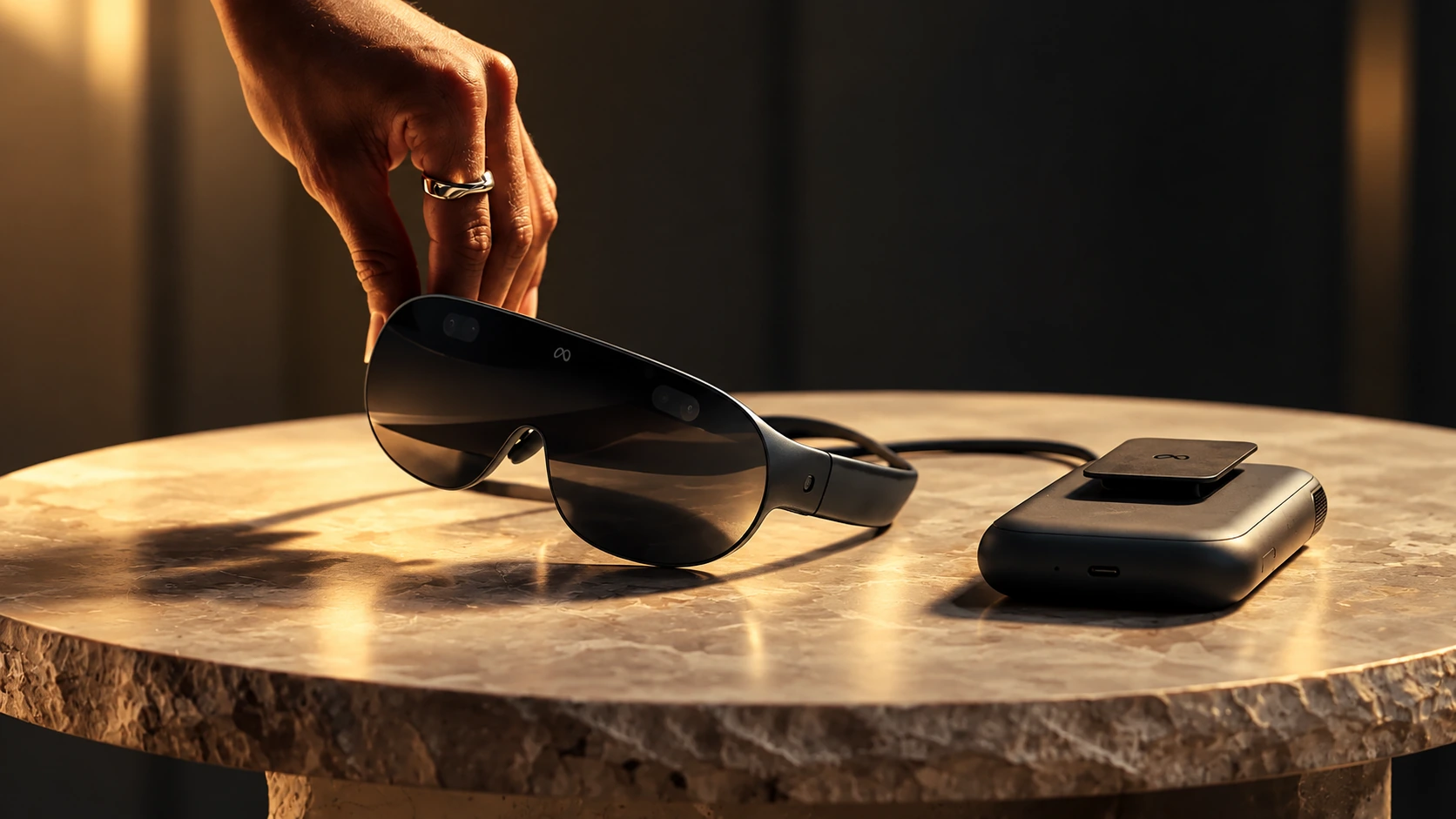
Meta VR Glasses are Meta’s biggest attempt yet to make immersive computing feel less like wearing a headset and more like putting on a pair of glasses. Announced at Meta Connect 2026, they weigh about 100 grams on the face, use micro-OLED displays, offload compute and battery to a separate puck, and will launch in spring 2027 for $1,299.99 in the United States.
The headline is comfort, but the more interesting story is what Meta is trying to combine: private cinema, live sports, gaming, workspace, Meta AI and hands-free controls in one device. Before treating them as the next obvious step after Quest 3, there are seven things worth understanding.
1. They are dramatically lighter than Quest 3
Meta says the glasses weigh about 100 grams, roughly one-fifth the weight of Quest 3. That is possible because the system is split in two. The displays and sensors stay on your face, while the processor, battery and storage live in a separate puck connected by an optical tether.
That design changes the physical experience in a meaningful way. The Verge’s hands-on report described the glasses as much easier to jump in and out of than a conventional strapped headset, even while noting that the puck remains part of the overall package. In other words, Meta is reducing face weight rather than eliminating hardware entirely.
2. The display is built for clarity, not just immersion
Meta uses what it calls a 5K Infinite Display based on micro-OLED panels. The system delivers 2,412 × 2,288 pixels per eye at 37 pixels per degree, with refresh rates up to 120Hz. Meta is also integrating Dolby Vision and Dolby Atmos.
That combination matters because Meta is positioning VR Glasses as much for movies and productivity as for games. Text legibility, small interface elements and long-form viewing become much more important when the device is supposed to function as a private monitor or cinema.
3. Entertainment is the clearest launch use case
Meta is leaning heavily into movies and sports. The company says the device will be the first IMAX Enhanced certified VR product, and it is working with Disney+, Prime Video, YouTube, DIRECTV, AMC+, Crunchyroll, Plex, ESPN and other services.
Meta also says users will be able to access 3D movies, immersive viewing environments and more than 100 live immersive sports events each year after launch. That could make the product easier to understand than earlier metaverse pitches: instead of asking people to imagine a virtual world, Meta is offering a giant private screen and premium seat for content they already know.
4. The puck is both the compromise and the reason the design works
The separate compute puck contains Qualcomm’s Snapdragon Reality Elite processor, 12GB of RAM, 128GB of storage and the battery. Meta rates the puck for up to three hours of continuous high-resolution media playback and supports 45W charging.
This split architecture is the central trade-off. The glasses stay light, but users still have to carry a tethered device in a pocket or bag. For some buyers, that is a reasonable compromise. For others, the cable may undermine the simplicity suggested by the word “glasses.”
5. Eye and hand tracking replace controllers for many tasks
Meta designed the system around eye tracking and natural hand gestures. You can look at an interface element to highlight it, then use hand movements to select, scroll or manipulate objects. Meta AI is integrated directly into the operating system for voice-based control.
Controllers are not required for the core experience. Meta says more than 75 games will support hands-first interaction at launch, while the broader Quest app catalog will remain accessible. Touch Plus controllers can still be paired for experiences that benefit from traditional VR input.
6. Meta is serious about turning them into a portable workspace
Meta is also pitching VR Glasses as a private multi-monitor workspace. The company says users can create several virtual screens and even turn a flat surface into a virtual keyboard and touchpad while still seeing the real environment through color passthrough.
The Verge’s hands-on found the virtual keyboard surprisingly usable for short interactions, although still slower than a real keyboard and mouse. That distinction matters: Meta VR Glasses may be useful for travel, quick work sessions and privacy-sensitive environments without necessarily replacing a laptop desk setup.
7. $1,299.99 puts them in a new category between Quest and Vision Pro
Meta VR Glasses will cost $1,299.99 in the U.S. when they go on sale in spring 2027. That is far above Quest 3 pricing, but well below Apple Vision Pro. The comparison is useful because Meta appears to be targeting buyers who want a more premium immersive experience without the weight and price of the most expensive spatial-computing headsets.
| Device | Positioning | Key trade-off |
|---|---|---|
| Meta Quest 3 | Mainstream standalone VR | Much heavier headset form factor |
| Meta VR Glasses | Lightweight premium immersive computing | External tethered puck |
| Apple Vision Pro | High-end spatial computing | Much higher price |
What about gaming?
Gaming remains part of the pitch, but it is not the only reason this product exists. Meta says more than 75 games will support hand-first interaction at launch, and the device will work with the existing Quest app catalog. Xbox Cloud Gaming support also expands the library beyond native VR titles.
This makes Meta VR Glasses more flexible than a media-only headset, but the strongest early demos still seem centered on viewing, communication and lightweight interaction rather than hardcore room-scale VR.
Hologram calling is ambitious, but it needs real-world proof
Meta is introducing hologram calling using photorealistic digital representations that reproduce expressions and reactions in real time. The company says the feature will work across calling apps including WhatsApp and Zoom.
The idea is compelling, but it is also one of the features that will need careful independent testing. Quality, latency, lighting, bandwidth and setup complexity can all affect whether hologram calling feels natural or remains mostly a showcase technology.
Should you wait for Meta VR Glasses?
If you are already interested in premium VR or spatial computing and dislike the weight of current headsets, Meta VR Glasses are worth watching closely. Their 100g face weight, micro-OLED displays, hands-first controls and entertainment partnerships address several of the biggest friction points in current VR hardware.
But this is still a pre-release product. The puck, three-hour media battery target, $1,299.99 price and unanswered questions around long-session comfort all matter. For most buyers, the sensible move is to wait for broader hands-on testing and final launch details before deciding.
QGH perspective
Meta VR Glasses may matter less because they are “VR glasses” and more because they represent a shift in how immersive hardware is packaged. Meta is trying to keep the visual immersion of a headset while removing the straps, bulk and psychological friction that make conventional VR feel like a commitment.
That makes them one of the most important hardware stories from Meta Connect 2026, but also one that deserves its own analysis beyond the event recap. For the broader announcements, see our Meta Connect 2026 coverage. You can also explore our Meta Muse Charm explainer, Tech News and Reviews.
Sources and methodology
This article is a research-based technical explainer, not a hands-on Quantum Gadget Hub test. Specifications, price and launch timing were checked against Meta’s official announcement. Hands-on impressions and usability observations were cross-checked against The Verge, TechCrunch and UploadVR. Manufacturer claims are identified as such rather than presented as independent measurements.